
I ❤️ BRUNO MARS BUT CREDIT WHERE CREDIT'S DUE
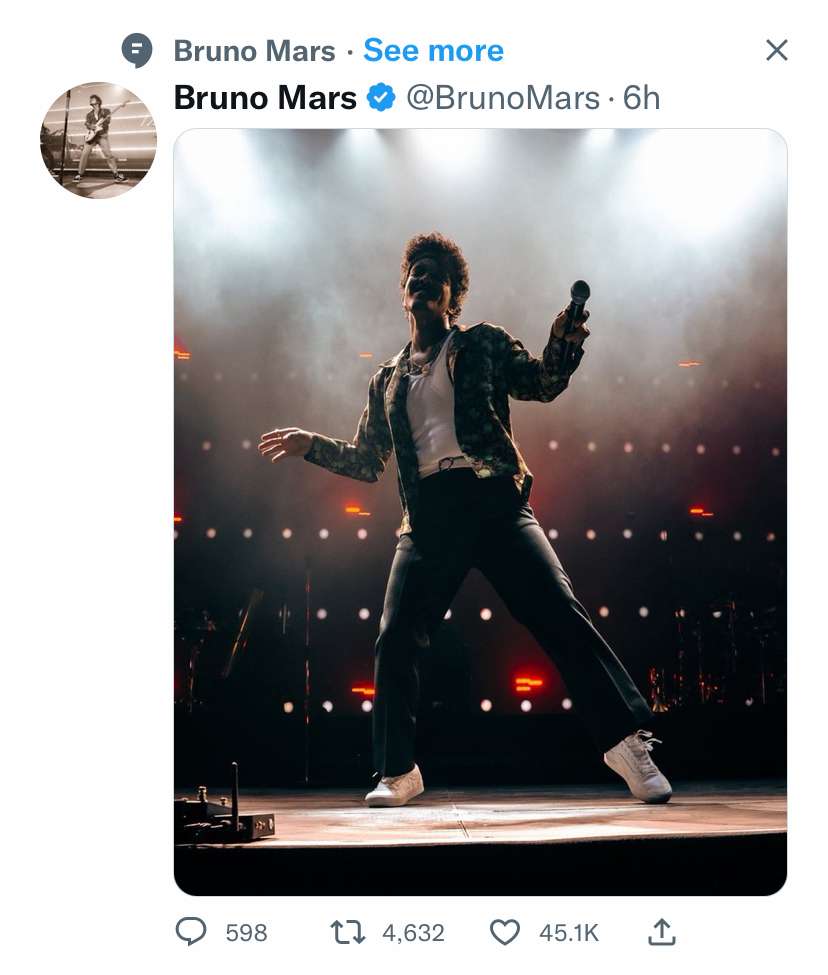
I happened to be idly scrolling through Twitter this weekend when I came across this post from @BrunoMars.
As you can see from the post (below), it simply contains the photo, no text or anything else. Clearly, Mr Mars (or whoever manages his account) was so taken with this shot that they decided it spoke for itself and would be a great promotion for him on its own. So it went on his feed for his 43.1 million followers to see.
However, my immediate reaction was - where’s the photographer's credit? It’s either an event photographer’s shot or possibly a photographer who is part of the Mars touring team but why doesn’t their name accompany the shot? I’m sure they'd appreciate those 43.1 million viewers seeing their name.
Even given that the photographer has been paid for his or her work, why would you not credit them?
Even if they don’t legally insist, it’s a usually accepted courtesy that you credit anyone whose work you use on your site/feed.
Now before the internet does its usual trick of taking the wrong end of the stick and running with it, let me repeat that I’m not suggesting Mr Mars or his team has done anything illegal. The photos have almost certainly been properly acquired by his management for reproduction.
My point is to ask the question why a credit to the creator of the work he so much admires is not present? If you reproduced Mr Mars’ work, or the work of any other creator on your social media or website, a credit would be given - music by, artwork by, web design by…
You expect to see it. My question is:
What has changed that it’s seen as ok not to credit a photographer anymore?
Part of it, I think, is that we are so used to seeing photographs online without any credit that we think nothing of it. We just expect photos to ‘be there’.
Also, I think that people think that if a photo is online or you have taken a photo of them, they have the right to reproduce it without payment or credit. This is SOOOO not the case but let me give you a true-life example of where this type of thinking can lead.
A few years ago, when I ran my web-design business, I was commissioned by a local artist to photograph their work at their home and then make a website for them. I worked on a flat-fee and as I knew the artist fairly well, made an exception and agreed full payment on completion.
I went to their home and took the photographs of their work, edited them and posted them in an online gallery for approval.
I received an email from the artist advising me that they were receiving treatment for an illness and would be out of the loop for a while but that they would get back to me as soon as they were feeling better.
A few months passed during which I heard nothing. Then, one morning, I opened my email to see a group email from this artist sent to 80-90 people, announcing that their new website was launching and inviting them to go and look at it. I did, only to see that my photographs had been downloaded and used on the site that someone else had made for them.
Given that the client and I had not even started on the design process for their site I was, as I’m sure you can imagine, both stunned and angry.
They had taken my photographs without my permission and used them without payment or consent.
This is why I now watermark shared images. However, the artist stated that they had used the photos ‘in all innocence’ as they ‘thought the photographs belonged to them’ as they were photos of their work.*
Now, in case you’re wondering what the law is in regard to photographs, it’s quite simple. The copyright to a photograph belongs to the person who took it, unless they have agreed otherwise. If I give you my camera and you take a photo on it, the copyright of that photo is yours, not mine.
Because of that, I need your permission to reproduce it and most photographers ask that a credit accompany their image. Even if they don’t insist, it’s a usually accepted courtesy that you credit anyone whose work you use on your site/feed. Certainly if it’s the sole image on a post.
So even if you have paid for an image by a photographer, if you’re going to use their work - especially for self-promotion - give them a credit like you would to anyone else whose work you would use on your site.
*After several terse emails I am pleased to report that I got paid in full for the job mentioned above as agreed. Emails to the site designer got no response. They should have known the law.