I KNOW WHY YOU TAKE PHOTOS - DO YOU?
The majority of first-time photography students tell me that they come to a beginner’s class because they simply want to take ‘nicer pictures’. However, I can assure you that, however certain they are of this belief, this is not the case. People drawn to photography are often unaware of their true motivation.
What actually motivates them, even if they don’t appreciate it themselves yet, is a subconscious desire to communicate. This may hardly seem an earth-shattering observation but it’s not the same as an artist looking to ‘express’ themselves. Photographers are rarely the ‘shout-from-a-soapbox’ type. They are more often quiet observationalists.
For most, photography is an act of sharing not of declaration.
I think that photography also holds its unique place in the arts - and also in the people it attracts - because of the immediacy of its creation. Click and it’s there..
Click and it’s there is very exciting.
Painting is not like that, nor is writing. Both of those arts take time and pre-planning to successfully create. Not that several styles of photography don’t require extensive pre-planning but the actual creation of the image is performed at the click of a button.
Take street photography.
Biter (above)
The world around us moves in perpetual motion and those motions are mostly mundane and uninteresting (otherwise we’d never get to work in the mornings). There will be split-seconds, however, where certain elements align and by being in the right place with the right lens, a fleeting moment of beauty can present itself in front of us - a true, ‘blink-and-it’s-gone’ moment. At this point only photography will do and a good street photographer, sensitive to hunting down those moments, proves their artistry.
Street photography is both the recording of a passing fragment of time and the interpretation of it artistically. The editing - as with all great photographs - is secondary. It’s capturing that confluence of events that makes art.
Street photography is a perfect example of sharing photography in that you can almost hear the photographer say: you were there but did you see it like this? Did you know that was there? I thought I’d share it with you because I liked it and thought you might, too?
And that’s just one strand of photography.
Landscape photography can do the same - a country lane you walk through weekly on a hike can suddenly be transformed by the momentary play of shadow and sunlight.
Portrait photography can take you through the eyes and expression of the subject into their thoughts and so express their feelings and fears.
Macro photography opens up a stunning world of colour and wonder in insects and flowers and the natural - and sometimes unnatural world - that surrounds us at all times.
Photographers share their sense of wonder and exploration with you.
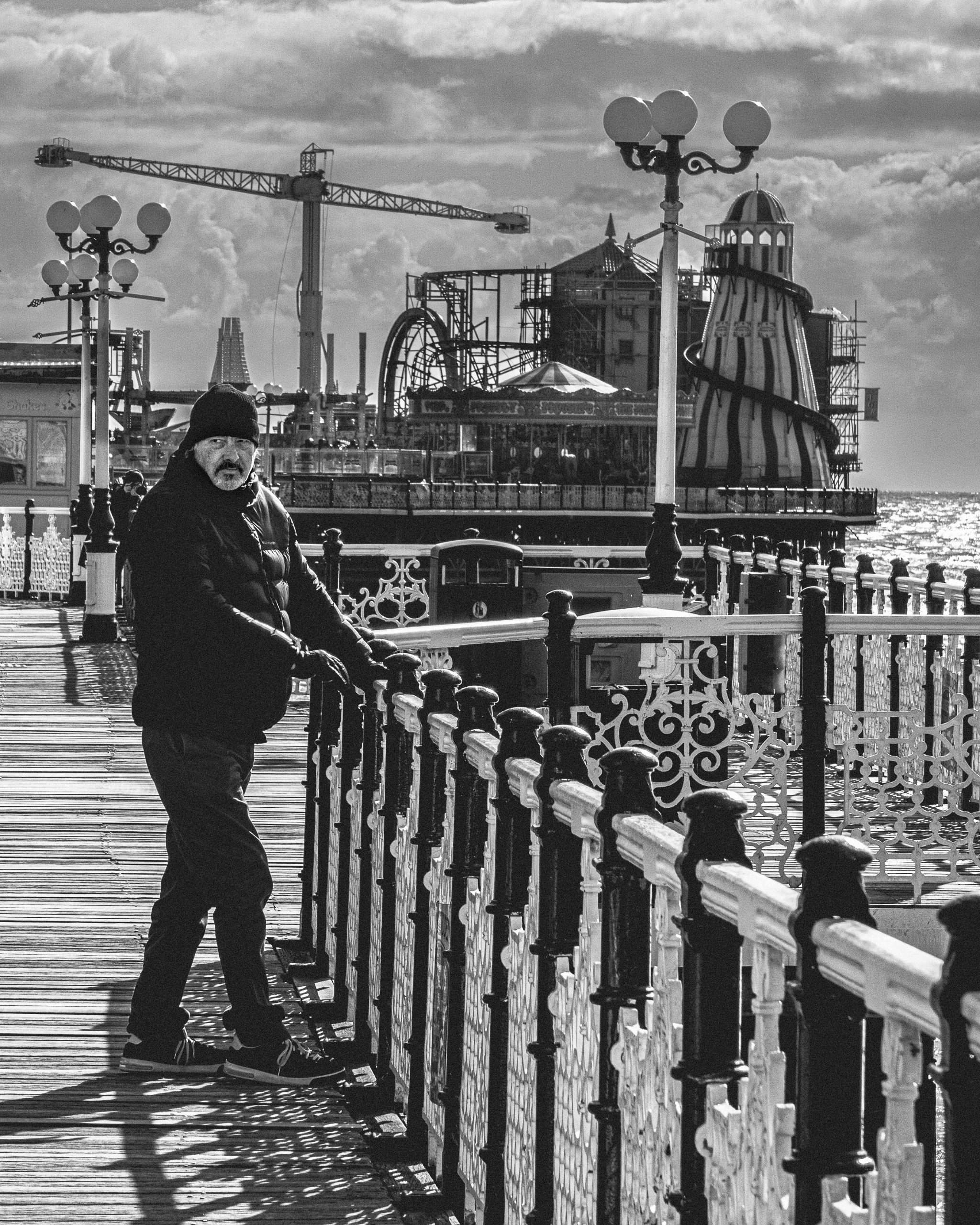
Shady Brighton
Towards the end of any beginners’ course there comes a moment with each student when I can almost literally hear the penny drop, when they realise that they’ve not come to you solely to increase their technical skills.
It’s usually when the student recognises that the technical skills that have previously eluded them are:
- Not so difficult to understand and attain and;
- Providing them with the ability to speak a language they’ve been trying to articulate for some time.
It’s this split-second record of something beautiful, interesting, shocking, funny or emotional that they want to share with others, the fleeting moment that expresses so much.
Photography becomes an articulation and sharing of emotion.
For many students, the desire to be able to do this is the true motive that draws them to photography in the first place, not simply the desire for ‘nicer pictures’ and that moment when the intangible gains form through their lens is a great one both for them and me.
And if you still think that all you really want to do is take ‘nicer photos’ and this is all just a bunch of florid nonsense, then consider this. Cameras these days are so good - even those in your phone - that it is almost impossible to get a technically bad shot (by which I mean a blurred, under or over-exposed photo).
So when you look at the photo you think is bad, it’s almost certainly not a technical issue. It’s that the photo doesn’t express what you felt when you saw that view - and to show and share that feeling is the true reason you put a camera up to your eye in the first place.
Hong Kong Card Game (below)